For the scholar, student, and
interested reader...
Subjects
Native
American
History & Culture
The Early Frontier
Colonial & Indian Wars
The
Missions
Indian Languages
Explorers &
Pioneers
American Dialects
|
Native
American History & Culture
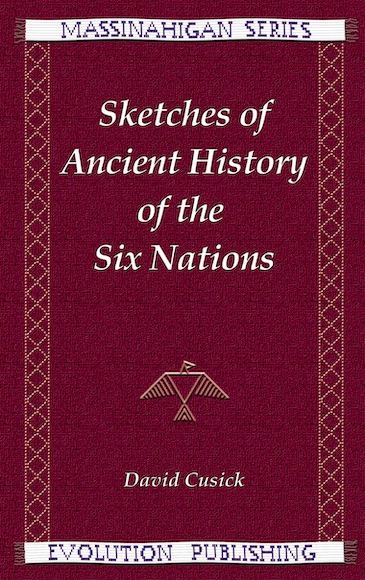
Sketches of
Ancient History of the Six Nations
By David Cusick
First published in 1825, this work represents one
of the earliest attempts to reconstruct
pre-contact Iroquois history. Compiled by David
Cusick, a Tuscarora historian, the book attempts
to relate events as far back as 1000 BC based on
the oral tradition of the Iroquois.
While Cusick himself
admits that much of the work is fabulous, mixing
accounts of wars and leaders with stories of
giants, floating heads, and poisonous blue otters,
it is inaccurate to classify the work as wholly
mythological. For example, the estimated dates he
offers for the southern migration of the Tuscarora
(AD 1) and the Iroquois proper becoming
independent nations (AD 500) compare well with
dates suggested by modern archaeology. Thus, while
it would be unreasonable to assume that the
traditions recorded in this work are precise, it
is clear that they likely contain a kernel of
ancestral memory of actual prehistoric events. As
it is, the work remains partly fact, partly fable,
and wholly invaluable to a study of Iroquois
history and folklore.
2024 ~ 76pp ~ hardcover ~ 978-1-935225-31-8 ~
18.95
|
|
Women in New
France
Extracts from
the Jesuit Relations
Compiled and Edited by Katherine E. Lawn &
Claudio R. Salvucci
Volume 5 presents extracts from the Jesuit
Relations that record first-hand
observations made by the Jesuit fathers in New
France regarding the roles, traditions, words, and
actions of both Native American and colonial
European women from 1634 to 1790. Together, these
extracts present a vivid, poignant, and emotional
portrait of the lives and deaths of women in early
colonial North America.
To best illustrate the
differing roles and changing circumstances
affecting women in this historical setting, the
extracts are organized chronologically according
to tribal, ethnic, and settlement groupings.
Covered in detail are the Montagnais, the various
Algonquin nations, the Hurons, Iroquois and
Iroquoian-speaking nations (Petun, Neutrals,
Eries, and Wenro). Extracts covering the tribes of
the lower Mississippi (Houmas, Chickasaw, Natchez,
etc.) and the plains (Sioux and Akensas) are also
included. Finally, several chapters include
extracts dealing with the lives of colonial French
women, Catholic nuns, and both native and European
women’s lives in the mission towns.
An introduction written by the
editors helps place the extracts in their
historical and cultural context and a bibliography
of related reading is included. A map of tribal
territories and movements from 1600–1700 is
provided, as well as useful appendices, including:
A synonymy of obscure tribal names contained in
the extracts and an index of principle persons
mentioned in the extracts.
2005 ~ 324pp ~ hardcover ~ 1-889758-39-6 ~
$75.00
|
This title qualifies for
a 10% discount when
ordered online
|
The Country
of the Neutrals
From Champlain
to Talbot
by James H. Coyne (1895)
This history, written in 1895, gives a brief
account of the country of the Neutral tribe, who
occupied numerous villages between the Grand and
Niagara Rivers in southern Ontario. Contact
population for the entire Neutral nation was
estimated to be 30-40,000, making them perhaps
more numerous than all of the five nations of the
Iroquois nations combined. They were termed
"Neutrals" because they historically did not take
sides in the ongoing wars between their neighbors
the Iroquois and the Hurons. The Neutrals
themselves were attacked and scattered by the
Iroquois in the early 1650s, leaving hardly a
trace of their language, history, and culture save
what was recorded by the few missionaries that
visited them beforehand. After their reduction by
the Iroquois, the remnants of the Neutral tribes
seem to have been absorbed by the Iroquois or
coalesced with refugees of the Petún and Hurons to
form the Wyandot tribe.
This book consolidates
accounts of the Neutrals recorded by early
explorers and missionaries such as Champlain, De
Laroche-Daillon, Sagard, Brebéuf, Chaumonot, and
others. Together, these accounts provide an
absorbing if fragmentary view of this once great
tribe. This book also covers the subsequent
inhabitants of the Neutral country: the Iroquois,
French, Delawares, Mohawks, and English up through
the beginning of the 19th century. The book
contains a short preface detailing the original
source of the work, is produced in a handy
small-format (4.25" x 6.75"), and features a
durable library binding and acid-free paper.
2004 ~ 80pp ~ BAENA3 ~ hardcover ~ 1-889758-60-4
~ $30.00
|

This title qualifies for
a 10% discount when
ordered online
|
David
Zeisberger's History of the Northern
American Indians in 18th Century Ohio,
New York, & Pennsylvania
Edited by Archer B. Hulbert & William
Nathaniel Schwarze (1910)
David Zeisberger was a Moravian missionary
who worked among the Indians of present-day New
York, Pennsylvania, and Ohio. His career lasted
more than 60 years and during that time, he became
intimately familiar with the tribes of the region.
This book brings to light many interesting stories
of Indian history, manners, and customs of
everyday life. This exceptionally detailed account
is found in few other places in the early
literature. Included are stories of Indian
medicinal remedies, firsthand details of their
ceremonies, food, culture and beliefs. Tribes
discussed include the Delawares, Shawnee,
Iroquois, Cherokee, Nanticokes, and many others.
2000 ~ 190pp ~ paperback ~ 1-889037-17-6 ~ out
of stock
|
|
The Life of
Tecumseh and His Brother the Prophet
A History of the
Shawnee
by Benjamin Drake (1855)
American historian Henry Trumbull stamped
Tecumseh as “the most extraordinary Indian that
has appeared in history,” and today, almost two
centuries after his death, Tecumseh still looms as
the greatest native leader in the long and tragic
struggle of the American Indians to hold on to
their homeland.
Written in 1841 and published
in 1855, this book describes the story of
that great leader and his people and their
struggle with life and their pursuit of an Indian
homelands fairly and accurately. Using many
original sources, including General Harrison’s
personal papers, Drake brings Tecumseh and the
Shawnee vividly to life once more.
1999 ~ 236pp ~ paperback ~ 1-889037-21-4 ~
out of stock
|
|
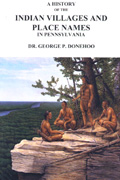
A History of
the Indian Villages and Place Names
in Pennsylvania
by George P. Donehoo (1928)
Perhaps
no state is richer in Indian names or history than
Pennsylvania. Indeed, Indian place names are
positively everywhere--Manayunk, Conshohocken,
Kittatinny, Wisahickon, Lackawana, Perkiomen,
Monongahela, Allegheny, etc. This book links
PA Indian place names to their correct form,
origin, and history. Each Indian name comes
complete with historical notes by the author. A
list of the authorities used is given with each
name and a general bibliography follows at the
conclusion of the work.
1998 ~ 290pp ~ paperback ~ 1-889037-117 ~ out of
stock
|
|
|
